
The hardest part of investing isn’t picking the right stocks or timing the market. It’s starting. Every year you delay costs you years of compounding — and compounding, over time, is the most powerful wealth-building force available to ordinary people.
This guide is a pure action plan. No theory for theory’s sake, no academic detours. Just seven concrete steps that take you from zero to making your first investment — with the right foundation to keep going for decades.
Step 1: Build Your Emergency Fund First
Before investing a single dollar in the stock market, you need 3–6 months of living expenses in a high-yield savings account. This isn’t optional — it’s the foundation everything else rests on.
Why this comes first: The stock market can decline 30–50% in any given year. If you invest without an emergency fund and a crisis hits (job loss, medical bill, car repair), you may be forced to sell investments at the worst possible time — locking in losses instead of riding through the recovery.
Where to keep it: High-yield savings accounts (HYSAs) currently offer 4–5% APY — meaningfully above traditional savings accounts. Your emergency fund should be liquid and accessible, not invested in stocks.
Target amount:
| Situation | Recommended Emergency Fund |
|---|---|
| Stable job, low fixed expenses | 3 months of expenses |
| Variable income (freelance, sales) | 6 months of expenses |
| Single income household | 6+ months of expenses |
| With dependents or health issues | 6–12 months of expenses |
Step 2: Clear High-Interest Debt
Credit card debt at 20–25% APR is a guaranteed 20–25% return when you pay it off — better than any stock market investment can reliably deliver. Paying down high-interest debt is the highest-return, zero-risk “investment” available.
The threshold: Pay off any debt with an interest rate above ~6–7% before investing. Below that threshold, the expected long-term stock market return (~7–10% historically) may exceed the guaranteed return of paying down debt — but this depends on your risk tolerance.
Student loans and mortgages at lower rates (3–5%) can generally be maintained while investing simultaneously — the math often favors investing while making minimum payments on low-rate debt.
Step 3: Understand Your Account Options
Where you invest matters almost as much as what you invest in. Tax-advantaged accounts can significantly improve long-term outcomes.
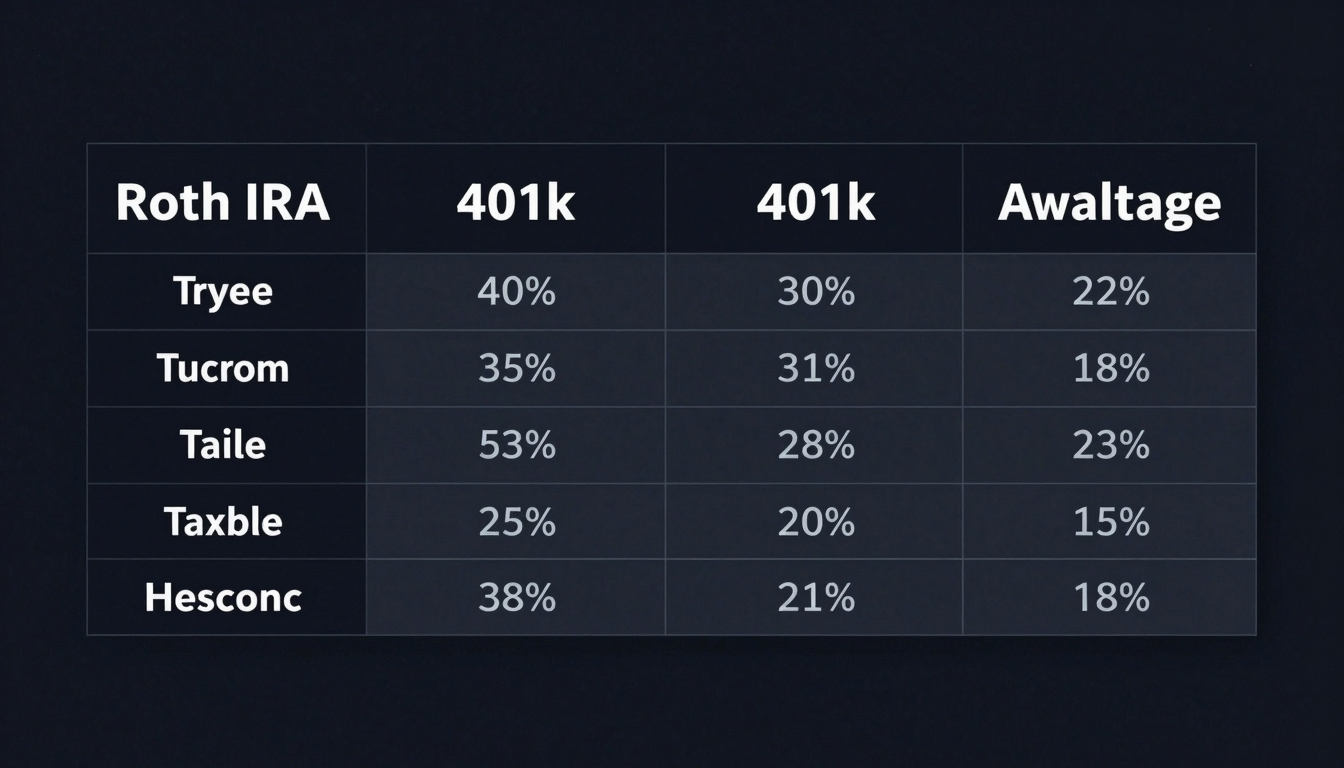
| Account Type | Tax Benefit | 2024 Contribution Limit | Best For |
|---|---|---|---|
| 401(k) / 403(b) | Pre-tax contributions; tax-deferred growth | $23,000 ($30,500 if 50+) | Employer-sponsored; especially valuable with employer match |
| Roth IRA | After-tax contributions; tax-FREE growth and withdrawals | $7,000 ($8,000 if 50+) | Best for those expecting to be in higher tax bracket at retirement |
| Traditional IRA | Pre-tax contributions (if eligible); tax-deferred growth | $7,000 ($8,000 if 50+) | Those expecting lower tax bracket at retirement |
| Taxable Brokerage | No tax advantage; but no contribution limits or restrictions | Unlimited | After maxing tax-advantaged accounts, or for shorter-term goals |
| HSA | Triple tax advantage: pre-tax in, tax-free growth, tax-free medical withdrawals | $4,150 individual / $8,300 family | Must have high-deductible health plan; exceptional for healthcare costs |
The optimal order for most people:
- 401(k) up to employer match (free money — always do this first)
- HSA if eligible (triple tax advantage)
- Roth IRA up to annual limit
- 401(k) up to annual limit
- Taxable brokerage account (unlimited)
Step 4: Choose a Brokerage
The brokerage landscape has converged dramatically — almost all major brokers now offer $0 commissions, fractional shares, and excellent mobile apps. The differences are marginal for most investors.
For beginners, prioritize:
- No account minimums — Start with any amount
- Fractional shares — Buy $50 of a $500 stock
- Clean interface — You’ll use this for decades; it should feel intuitive
- Educational resources — Good brokers invest in helping their users learn
Well-regarded options: Fidelity (top-rated for beginners, excellent research), Schwab (strong all-around, great customer service), Vanguard (ideal for long-term index fund investors), and others. For a complete walkthrough of opening your first account, see our guide on how to open a brokerage account.
Step 5: Make Your First Investment
For most beginning investors, the right first investment is not an individual stock — it’s a broad market index fund.
Why index funds first:
- Instant diversification across hundreds or thousands of companies
- Ultra-low costs (expense ratios as low as 0.03%)
- Outperforms the majority of actively managed funds over 10+ years
- No research required — you own the entire market
- Removes the risk of picking a single stock that underperforms
Three starting points for most investors:
| Fund | What It Owns | Expense Ratio | Ticker |
|---|---|---|---|
| Total US Market Index | ~3,500+ US stocks, all cap sizes | 0.03% | VTI (Vanguard), FSKAX (Fidelity) |
| S&P 500 Index | 500 largest US companies | 0.03% | VOO (Vanguard), FXAIX (Fidelity), IVV (iShares) |
| Total World Index | US + international stocks | 0.07% | VT (Vanguard), FWWFX (Fidelity) |
If you want to invest in individual stocks instead — or in addition to index funds — our guides on how to pick stocks and best stocks to invest in cover the full methodology.
Step 6: Set Up Automatic Contributions
The single most powerful thing you can do after making your first investment: automate it.
Set a recurring transfer — weekly, bi-weekly, or monthly — from your checking account to your investment account. Then set the investment account to automatically invest that contribution in your chosen fund.
Why automation beats manual investing:
- Removes behavioral friction — you never have to “decide” to invest
- Forces dollar-cost averaging automatically — you buy more when prices are low, less when they’re high
- Removes the temptation to time the market — the decision is already made
- Builds investing as a habit rather than an occasional action
Even $100/month invested consistently from age 25 grows to approximately $350,000 by age 65 at a 7% average annual return — without ever increasing contributions. Increasing that amount over time as income grows produces dramatically larger outcomes.
For the full framework on automated investing and its compounding power, see our guide on dollar-cost averaging.
Step 7: Build Your Knowledge Over Time
Starting with index funds doesn’t mean staying there forever. As you invest consistently and build confidence, you may want to:
- Add individual stocks alongside your core index fund holdings
- Diversify into bonds or international stocks as your portfolio grows
- Develop a deeper understanding of valuation and company analysis
- Optimize for tax efficiency as your income and portfolio grow
The key is building knowledge progressively — not trying to master everything before starting. Start simple, start now, and add complexity only as it’s warranted by your portfolio size and confidence level.
The Investing Roadmap: Where You Are and Where You’re Going
| Stage | Portfolio Size | Focus | Key Actions |
|---|---|---|---|
| Foundation | $0 – $10K | Habit formation, tax setup | Emergency fund, open IRA/401k, first index fund, automate |
| Accumulation | $10K – $100K | Consistency, diversification | Max tax-advantaged accounts, add sector diversity, begin reading |
| Growth | $100K – $500K | Optimization, individual stocks | Taxable brokerage, stock picking if desired, rebalancing discipline |
| Wealth Building | $500K+ | Tax efficiency, income | Estate planning, tax-loss harvesting, dividend income optimization |
Common Beginner Mistakes to Avoid
Waiting for the “Right Time”
There is no right time. Markets are at all-time highs roughly 30% of the time — buying at all-time highs and holding for 10+ years has historically produced positive returns. The cost of waiting is paid in compounding years lost.
Checking Your Portfolio Daily
Daily price checking is the fastest path to bad decisions. Stock prices fluctuate constantly for reasons that have nothing to do with the underlying business. Check your portfolio quarterly at most — monthly if you’re disciplined. Never trade based on daily movements.
Investing Money You’ll Need Soon
The stock market is for money you won’t need for at least 3–5 years. Shorter time horizons belong in savings accounts or short-term bonds. Markets can and do fall 30–50% — you need time to ride out downturns without being forced to sell.
Chasing Last Year’s Winners
The funds and sectors that performed best last year are often the worst performers the next year. Sector rotation is real. Buy based on valuation and fundamentals, not recent momentum.
Trying to Pick the Bottom
Nobody consistently picks market bottoms. Investors who wait for “a better price” during a decline often miss the recovery entirely — and the best days in markets frequently come immediately after the worst days.
Common Questions About Starting to Invest
How much money do I need to start investing?
Most major brokers now have no account minimums. With fractional shares, you can invest as little as $1. The “right” amount to start is whatever you can consistently commit to — even $50 per month builds meaningful wealth over decades through compounding.
Is now a good time to start investing?
For long-term investors (10+ year horizon), the answer is almost always yes. The best time to plant a tree was 20 years ago; the second best time is today. Every year of delay is a year of compounding permanently lost.
Should I invest in stocks or bonds as a beginner?
For most young investors with a long time horizon, a heavy stock allocation (80–100%) makes sense — stocks have higher long-term returns, and you have time to ride out volatility. As you approach a goal (retirement, home purchase), gradually shift toward bonds for stability.
What if the market crashes right after I invest?
This will likely happen at some point. If your time horizon is 10+ years, a crash in your first year is actually beneficial — your ongoing contributions buy more shares at lower prices, which compounds into greater wealth at recovery. The only way to be hurt is to sell. Don’t sell.
How do I know when to sell?
For index funds: almost never, except to rebalance or when you need the money. For individual stocks: when the fundamental investment thesis has changed, the business has deteriorated structurally, or the stock has become significantly overvalued relative to fair value. “The price fell” is never a reason to sell.
📚 Continue Your Investing Journey
- Stock Market for Beginners — complete foundation guide
- How to Open a Brokerage Account — step-by-step account setup
- Dollar-Cost Averaging — the automated investing strategy
Leave a Reply